原文:
Serenity 白毛女-中文翻译(公开)
Serenity 白毛女-中文翻译(公开)
原文:
As a earnings recap: $AMZN, $META, $GOOGL, and $MSFT guided a 2026 combined capex forecast to ~$720-$745 Billion.
Up from $695-$725B Billion previously.
Amazon: $220B
Google: $195B-$205B
Meta: $130B-$145B
Microsoft: $175B
We've already seen significant deleveraging and retail/institutional margin liquidations (maybe it continues for more time, who knows).
But medium-long term, I'm not quite sure how anyone can be bearish the upstream semis or neoclouds.
Given each hyperscaler has flagged either compute shortages, rising cloud demand + pricing power, or increased spending for chips/networking.
My "bottleneck" thesis with many of these upstream semi supply chains is that when trillions in capital flows into things from InP substrates or memory (which were both treated as cheap commodities) or even energy.
Lot of these current AI names that were treated as useless before in telecom cycles or even toilet sellers.
Gets rerated when their inflection period hits and capex flows into their balance sheets.
As seen with $NVDA GPUs past few years, memory this year, CPUs/MLCCs next few years, CPO in 2027, Glass Substrates in 2027, 800V in 2027, and so on.
翻译:
作为收益回顾:$AMZN、$META、$GOOGL 和 $MSFT 指出 2026 年综合资本支出预测为约 720-7450 亿美元。
较之前的 695-7250 亿美元有所上升。
亚马逊:2200 亿美元
谷歌:1950-2050 亿美元
Meta:1300-1450 亿美元
微软:1750 亿美元
我们已经看到显著的去杠杆和零售/机构保证金清算(可能会继续一段时间,谁知道)。
但中长期来看,我不太确定为什么有人会看空上游半导体或新云计算。
鉴于每个超大规模云计算公司都提到了计算资源短缺、云计算需求增长+定价权或芯片/网络支出增加。
我关于许多上游半导体供应链的“瓶颈”论点是,当数万亿资本流入诸如磷化物基底板或内存(这些曾经被视为廉价商品)甚至能源等领域时。
许多当前的 AI 公司曾经在电信周期或甚至马桶销售者中被视为无用的东西。
当它们的拐点期到来,资本支出流入它们的资产负债表时,就会被重新评估。
如同过去几年中 $NVDA 的 GPU、今年的内存、未来几年的 CPU/MLCC、2027 年的 CPO、2027 年的玻璃基板、2027 年的 800V 等所见。
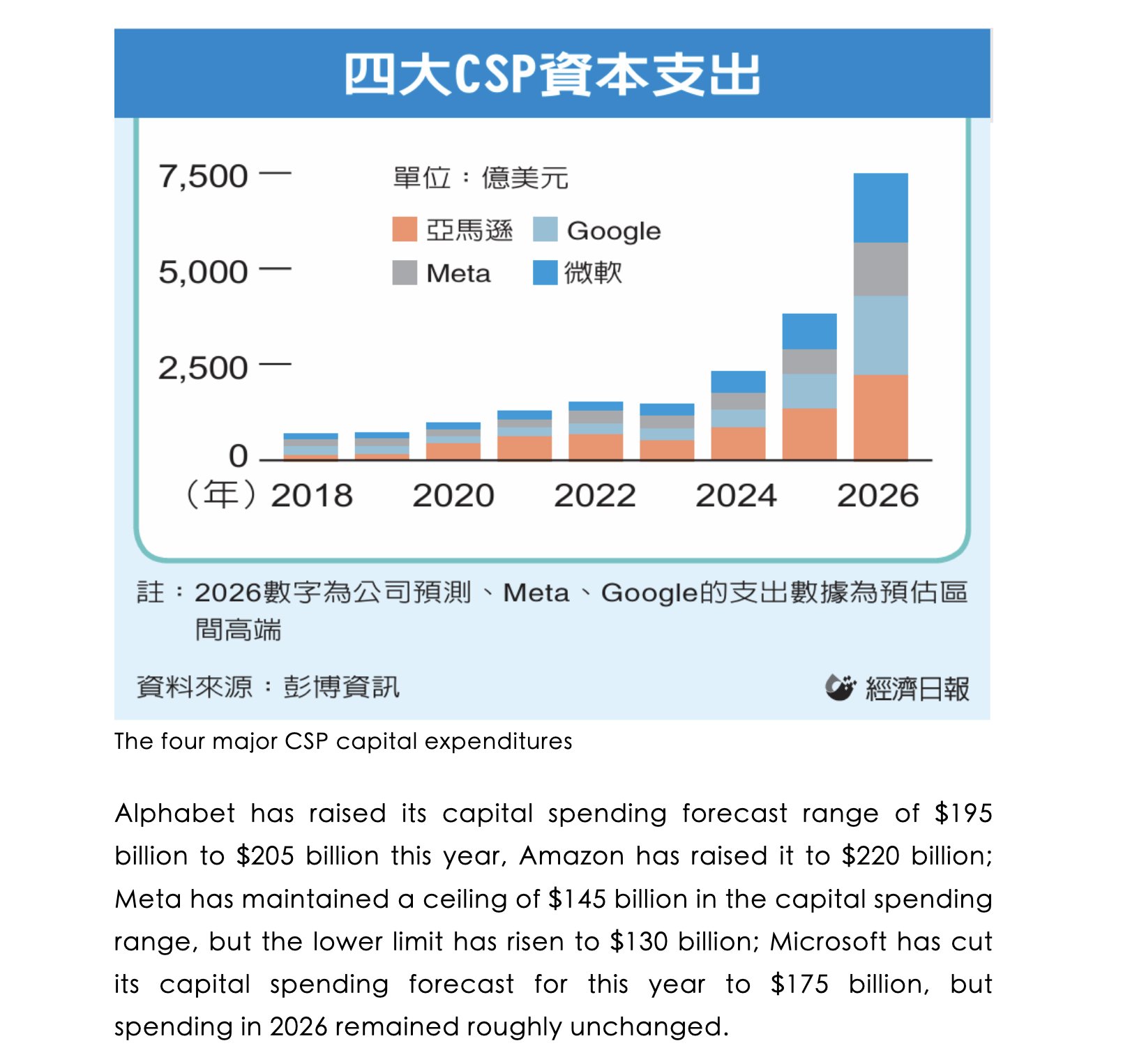
As a earnings recap: $AMZN, $META, $GOOGL, and $MSFT guided a 2026 combined capex forecast to ~$720-$745 Billion.
Up from $695-$725B Billion previously.
Amazon: $220B
Google: $195B-$205B
Meta: $130B-$145B
Microsoft: $175B
We've already seen significant deleveraging and retail/institutional margin liquidations (maybe it continues for more time, who knows).
But medium-long term, I'm not quite sure how anyone can be bearish the upstream semis or neoclouds.
Given each hyperscaler has flagged either compute shortages, rising cloud demand + pricing power, or increased spending for chips/networking.
My "bottleneck" thesis with many of these upstream semi supply chains is that when trillions in capital flows into things from InP substrates or memory (which were both treated as cheap commodities) or even energy.
Lot of these current AI names that were treated as useless before in telecom cycles or even toilet sellers.
Gets rerated when their inflection period hits and capex flows into their balance sheets.
As seen with $NVDA GPUs past few years, memory this year, CPUs/MLCCs next few years, CPO in 2027, Glass Substrates in 2027, 800V in 2027, and so on.
翻译:
作为收益回顾:$AMZN、$META、$GOOGL 和 $MSFT 指出 2026 年综合资本支出预测为约 720-7450 亿美元。
较之前的 695-7250 亿美元有所上升。
亚马逊:2200 亿美元
谷歌:1950-2050 亿美元
Meta:1300-1450 亿美元
微软:1750 亿美元
我们已经看到显著的去杠杆和零售/机构保证金清算(可能会继续一段时间,谁知道)。
但中长期来看,我不太确定为什么有人会看空上游半导体或新云计算。
鉴于每个超大规模云计算公司都提到了计算资源短缺、云计算需求增长+定价权或芯片/网络支出增加。
我关于许多上游半导体供应链的“瓶颈”论点是,当数万亿资本流入诸如磷化物基底板或内存(这些曾经被视为廉价商品)甚至能源等领域时。
许多当前的 AI 公司曾经在电信周期或甚至马桶销售者中被视为无用的东西。
当它们的拐点期到来,资本支出流入它们的资产负债表时,就会被重新评估。
如同过去几年中 $NVDA 的 GPU、今年的内存、未来几年的 CPU/MLCC、2027 年的 CPO、2027 年的玻璃基板、2027 年的 800V 等所见。
Could not load this section.